
Night Parking Master looks simple. You drive a sports car through a dark car park and stop inside a glowing bay. The catch is that a single touch of a cone, a lamp post, a wall or another car ends the attempt. Ten levels take you from an easy straight-in bay to angled spaces, a zigzag of barriers and two tight parallel parks. These tips will help you clear all of them and collect the three-star times.
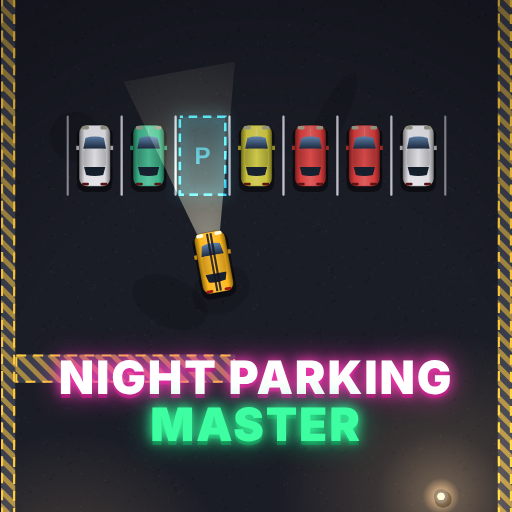 Night Parking MasterNight Parking Master is a top-down car parking game set in a quiet city after dark. Your job sounds simple: drive you... Play free
How the car steers
The car turns around its wheels the way a real car does. It cannot spin on the spot, and the tighter you steer, the more space the back of the car needs to follow. Once you understand that, the levels stop feeling random.
- Keyboard: arrow keys or WASD to drive and steer. Down or S brakes first, then reverses.
- Mobile: on-screen steering, gas and reverse buttons.
10 tips that make a real difference
- Drive slowly. Speed is the number one cause of failed attempts. At low speed you have time to correct, and stopping inside the bay is much easier.
- Look at the whole level first. Before touching the controls, find the bay and trace a route in your head. Most levels have one obvious line and several tempting short cuts that end in a scrape.
- Line up early. For narrow bays, get the car pointing straight a little way before the entrance instead of turning at the last second.
- Start turns earlier than feels natural. Because the rear wheels cut inside the front ones, a late turn swings the back of the car into whatever is on the corner.
- Use reverse freely. Two short moves are almost always better than one long, risky turn. There is no penalty for reversing.
- Watch the corners of your car, not the centre. Collisions happen at the bumpers and the rear corners, so keep an eye on them when passing obstacles.
- Stop fully and wait. The level only finishes when the car is completely inside the box and the ring has filled. Rolling slightly out of the bay cancels it.
- Parallel parking: pull level with the space, then reverse in while steering towards the kerb, and straighten up as the car slides in.
- Zigzag levels: treat each gap as its own small parking move. Stop, line up, then drive through.
- Chase stars later. First learn the clean route. Once you can park safely every time, replay the level and simply drive the same line a little faster.
Reference points: how to know where your car really is
Drivers who park well rarely guess. They use reference points: fixed spots on the car that line up with something outside it at the right moment. You can use the same idea in Night Parking Master because the camera looks straight down on the car park.
- The front bumper tells you when to stop. Bring it to the far line of the bay and no further.
- The rear wheels are your pivot point. When you start a turn, the car swings around them, so line them up with the corner you are turning around, not the front of the car.
- The side mirrors' position (roughly a third of the way back) is a good marker for when to start turning into a side bay: when it passes the near edge of the bay, begin steering.
After a few attempts, these points become automatic, and you will find yourself starting each turn at exactly the same place every time. That consistency is what turns a lucky three-star run into a reliable one.
Speed control: the one skill that fixes everything
Almost every failed attempt has the same root cause: the car was moving faster than the player could think. Because the car keeps rolling for a moment after you lift off the gas, a burst of speed near an obstacle leaves no time to correct. Try this habit for a few levels:
- Tap the gas briefly to start moving, then let go and let the car roll.
- Steer while the car is rolling slowly, not while you are accelerating.
- Tap the brake early, before you reach the bay, so the car arrives at walking pace.
- Make the final adjustment with tiny taps forward or back.
It feels slow at first, but you will finish levels in fewer attempts, which is faster overall.
What to do when you are stuck on one level
Every player hits a level that seems impossible. Before you give up, try three things. First, stop and watch the level for a few seconds without moving, tracing the route with your eyes. Second, try the exact opposite approach to the one you have been using: if you keep driving in forwards, reverse in; if you keep coming from the left, try the right. Third, take a short break. Coming back after five minutes often makes the route obvious, because you stop repeating the same mistake from muscle memory.
How three stars work
Every level has a target time. Park cleanly within it and you earn all three stars. Because touching anything restarts the level, a slightly slower clean run always beats a fast run that clips a cone. Many players find their best times come on the second or third replay, once the route is automatic.
Keep in mind that the best runs rarely look dramatic. They are calm, steady and a little boring to watch, which is exactly what a perfect parking job should be.
Common mistakes
- Holding the gas through a turn. Lift off, steer, then accelerate again once the car is pointing the right way.
- Trying to fix a bad angle by driving forwards. Reverse a little and start the approach again.
- Forgetting the car's length when reversing into a bay. The rear of the car reaches the back line sooner than you expect.
Understanding "off-tracking": the secret behind every scrape
The single most useful idea for this game has a name in real driving: off-tracking. When a car turns, its rear wheels do not follow the same path as its front wheels. They take a shorter line, cutting inside the curve. The longer the car and the sharper the turn, the bigger the difference.
In practice this means the inside rear corner of your car is the part most likely to clip a cone, a lamp post or a parked car as you go round a bend. If you keep failing a level at the same corner, the fix is almost always the same: drive a little further forward before you start turning, so the back of the car has room to follow.
Next time you clip something on a turn, look at which part of the car touched it. If it was the back corner on the inside of the turn, you turned too early. If it was the front corner on the outside, you turned too late or too fast.
How to tackle each type of level
Straight-in bays
These early levels teach the basics. Drive slowly towards the glowing box, keep the car centred, and come to a complete stop with all four corners inside the lines. Practise stopping smoothly here, because a perfect stop is needed on every later level too.
Side bays between parked cars
When the bay is at a right angle to the lane, swing slightly away from it first to make your turn wider, then steer in. That small outward swing gives the rear of the car the extra space it needs. If the gap is very tight, it is usually easier to drive past the bay and reverse into it, because a car steers more sharply when it moves backwards.
Angled bays
Slanted bays look harder but are often the easiest once you see the trick: approach so that your car is already pointing roughly along the angle of the bay. Then only a small steering correction is needed as you enter. Trying to turn sharply into an angled bay from the wrong direction is the most common way to hit the neighbouring car.
Zigzag barrier courses
Treat a zigzag as a chain of small, separate moves rather than one long drive. Stop completely after each gap, check the angle of the car, and line up for the next gap before moving again. It feels slow, but it is much faster than restarting the level five times.
Parallel parking
The classic method works perfectly in the game:
- Stop alongside the car parked in front of the space, roughly level with it and a small gap away.
- Reverse slowly and steer fully towards the kerb side.
- When the car is at about a 45-degree angle, straighten the steering and keep reversing.
- As the front of your car clears the car in front, steer fully the other way to swing the nose into the space.
- Straighten up and move forward or back a little to centre the car inside the box.
Keyboard or touch: which is easier?
Both work well, but they reward slightly different habits.
- Very precise, quick taps for small corrections.
- Easy to hold steering and gas together.
- Best for chasing three-star times.
- Rest your thumbs on the buttons instead of tapping hard.
- Play in landscape and full screen for bigger buttons.
- Short presses of the gas work better than holding it down.
Whichever you use, the most important habit is the same: make small, short inputs. Holding the gas or the steering for a long time is what turns a small mistake into a crash.
A 10-minute practice routine
If you are stuck, try this simple routine instead of replaying the same hard level again and again:
- Minutes 1 to 3: replay an early level and focus only on stopping perfectly in the centre of the box.
- Minutes 4 to 6: replay a level with side bays and practise reversing in instead of driving in forwards.
- Minutes 7 to 10: go back to the level you were stuck on. Drive it slowly once just to finish it, then try again for the stars.
Breaking the skill into small pieces like this is how people learn to park real cars too, and it is surprisingly effective in a game.
Parking in a game versus parking a real car
The game is a fun way to understand ideas like turning circles, reference points and reversing into bays, but it is not a driving lesson. Real cars have mirrors, blind spots, pedestrians and other drivers to think about, and the only right way to learn is with a qualified instructor. Think of Night Parking Master as a puzzle about angles and patience, not as practice for the road.
Why parking games are good practice
Parking puzzles reward planning, patience and spatial awareness: picturing where the car will be two moves from now. Those are useful skills in many other games too, especially puzzles and other driving challenges.
If you enjoy careful driving, you might also like the other games in our Driving and Racing & Driving categories.